Week 5 — Oct 12: Atomic Spectroscopy (Risk Homework)
Where UV-Vis measures molecules, atomic spectroscopy measures elements: flame and graphite-furnace AA, ICP-OES, and ICP-MS; the ICH Q3D risk-assessment and permitted-daily-exposure framework by element class; the method under USP ⟨232⟩–⟨233⟩; and the worked history of the withdrawn colorimetric heavy-metals test as a lesson in specificity. Carries the second risk-homework checkpoint.
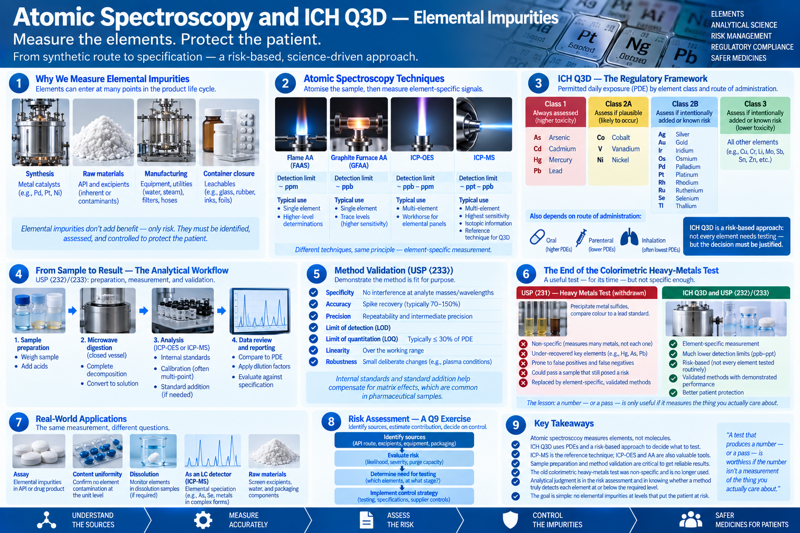
One-page overview of 'Atomic Spectroscopy and ICH Q3D — Elemental Impurities,' subtitled 'Measure the elements. Protect the patient.' with the tagline 'From synthetic route to specification — a risk-based, science-driven approach.' Nine numbered panels: (1) Why We Measure Elemental Impurities — elements can enter at many points in the product life cycle: synthesis (metal catalysts, e.g. Pd, Pt, Ni), raw materials (API and excipients, inherent or contaminants), manufacturing (equipment, utilities, water, steam, filters, hoses), and container closure (leachables — glass, rubber, inks, foils), with the note that elemental impurities don't add benefit, only risk, and must be identified, assessed, and controlled to protect the patient; (2) Atomic Spectroscopy Techniques — atomise the sample then measure element-specific signals, across Flame AA/FAAS (detection limit ~ppm, single element, higher-level determinations), Graphite Furnace AA/GFAA (detection limit ~ppb, single element trace levels, higher sensitivity), ICP-OES (detection limit ~ppb-ppm, multi-element, workhorse for elemental panels), and ICP-MS (detection limit ~ppt-ppb, multi-element, highest sensitivity, isotopic information, reference technique for Q3D), noting different techniques, same principle — element-specific measurement; (3) ICH Q3D — The Regulatory Framework, permitted daily exposure (PDE) by element class and route of administration: Class 1 'always assessed, higher toxicity' (As, Cd, Hg, Pb), Class 2A 'assess if plausible, likely to occur' (Co, V, Ni), Class 2B 'assess if intentionally added or known risk' (Ag, Au, Ir, Os, Pd, Pt, Rh, Ru, Se, Tl), Class 3 'assess if intentionally added or known risk, lower toxicity' (all other elements e.g. Cu, Cr, Li, Mo, Sb, Sn, Zn), also noting the assessment depends on route of administration — oral (higher PDEs), parenteral (lower PDEs), inhalation (often lowest PDEs) — and that ICH Q3D is a risk-based approach: not every element needs testing, but the decision must be justified; (4) From Sample to Result — The Analytical Workflow (USP ⟨232⟩/⟨233⟩: preparation, measurement, and validation) — 1. sample preparation (weigh sample, add acids), 2. microwave digestion (closed vessel, complete decomposition, convert to solution), 3. analysis by ICP-OES or ICP-MS (internal standards, calibration often multi-point, standard addition if needed), 4. data review and reporting (compare to PDE, apply dilution factors, evaluate against specification); (5) Method Validation (USP ⟨233⟩) — demonstrate the method is fit for purpose: specificity (no interference at analyte masses/wavelengths), accuracy (spike recovery typically 70-150%), precision (repeatability and intermediate precision), limit of detection (LOD), limit of quantitation (LOQ, typically ≤30% of PDE), linearity (over the working range), robustness (small deliberate changes e.g. plasma conditions), with the note that internal standards and standard addition help compensate for matrix effects, common in pharmaceutical samples; (6) The End of the Colorimetric Heavy-Metals Test — contrasting USP ⟨231⟩ Heavy Metals Test (withdrawn): precipitate metal sulfides, compare colour to a lead standard — non-specific (measures many metals, not each one), under-recovered key elements (e.g. Hg, As, Pb), prone to false positives and negatives, could pass a sample that still posed a risk, replaced by element-specific validated methods — versus ICH Q3D and USP ⟨232⟩/⟨233⟩: element-specific measurement, much lower detection limits (ppb-ppt), risk-based (not every element tested routinely), validated methods with demonstrated performance, better patient protection; with the lesson that a number — or a pass — is only useful if it measures the thing you actually care about; (7) Real-World Applications — the same measurement, different questions: assay (elemental impurities in API or drug product), content uniformity (confirm no element contamination at the unit level), dissolution (monitor elements in dissolution samples if required), as an LC detector/ICP-MS (elemental speciation, e.g. As, Se, metals in complex forms), raw materials (screen excipients, water, and packaging components); (8) Risk Assessment — A Q9 Exercise, a vertical flow: identify sources (API route, excipients, equipment, packaging) → evaluate risk (likelihood, severity, purge capacity) → determine need for testing (which elements, at what stage) → implement control strategy (testing, specifications, supplier controls); (9) Key Takeaways — atomic spectroscopy measures elements, not molecules; ICH Q3D uses PDEs and a risk-based approach to decide what to test; ICP-MS is the reference technique, ICP-OES and AA are also valuable tools; sample preparation and method validation are critical to get reliable results; the old colorimetric heavy-metals test was non-specific and is no longer used; analytical judgment is in the risk assessment and in knowing whether a method truly detects each element at or below the required level; the goal is simple — no elemental impurities at levels that put the patient at risk; with a pull-quote 'A test that produces a number — or a pass — is worthless if the number isn't a measurement of the thing you actually care about.' A closing chevron strip reads: understand the sources → measure accurately → assess the risk → control the impurities → safer medicines for patients.

(Lecture 5.) NMR was MAI’s the last two weeks; this week the AF/SM thread picks back up where Week 2 left it, with the first of three technique weeks — atomic spectroscopy, then molecular spectroscopy, then separations and mass spectrometry. The API-synthesis section flagged metal catalysts as a source of elemental impurities. This week is where that risk gets measured, and where it either clears a limit or has to be controlled.

The one idea

A test that produces a number — or a pass — is worthless if the number isn’t a measurement of the thing you actually care about.

Atomic spectroscopy — the technique family

Where UV-Vis measures molecules, atomic spectroscopy measures elements: atomise the sample, then measure absorption or emission at element-specific wavelengths, or count ions by mass.

TechniqueDetectionTypical use
Flame AAppmSingle-element, higher-level (e.g. residual catalyst at limit)
Graphite furnace AA (GFAA)ppbSingle-element trace
ICP-OESppb–ppm, multi-elementWorkhorse for panels of elements
ICP-MSppt–ppb, multi-element, isotopicTrace elemental impurities; the Q3D reference technique

The regulatory frame — ICH Q3D / USP ⟨232⟩–⟨233⟩

Q3D sets permitted daily exposures (PDEs) for elemental impurities by route of administration, grouped into classes: Class 1 (As, Cd, Hg, Pb — always assessed), Class 2A (Co, V, Ni — likely, assess if plausible), Class 2B and Class 3 (assessed only if intentionally added, such as a catalyst named in the synthesis, or otherwise a known risk). The analyst’s job splits in two:

  • The risk assessment — where could each element come from (drug-substance synthesis and catalysts — the API-synthesis section’s Pd, Pt, Ni couplings, for instance), excipients, water, manufacturing equipment, container closure — and does the total plausibly approach the PDE? This is a Q9 risk-management exercise, and it decides whether routine testing is even needed.
  • The method — closed-vessel microwave digestion, then ICP-OES or ICP-MS, validated per USP ⟨233⟩ (specificity, accuracy by spiked recovery, precision, a demonstrated limit) with internal standards and often standard addition for matrix effects.

Worked case — from “heavy metals” to element-specific testing

Until the 2010s, most pharmacopeias controlled elemental impurities with a single colorimetric heavy-metals test (the old USP ⟨231⟩): precipitate metal sulfides, compare the resulting brown colour to a lead standard, report pass/fail. It was cheap and universal — and wrong in both directions. It under-recovered the elements of most concern (mercury, and much of the arsenic and lead, were lost in sample preparation) and it flagged samples on colour that had nothing to do with toxic metals. ICH Q3D and USP ⟨232⟩/⟨233⟩ replaced it with a risk assessment plus element-specific, validated instrumental methods. The lesson is specificity: a test that produces a number, or a pass, is worthless if the number isn’t a measurement of the thing you care about.

Risk-assessment assignment (Risk Homework, checkpoint 1 of 3)

Using the FMEA / risk-ranking approach from Week 2: take a drug product of your choice and build the Q3D elemental-impurity risk assessment — sources (starting with the synthetic route), contributions, and a defended conclusion on which elements, if any, need routine testing and at what stage. The same assignment structure returns at molecular spectroscopy and mass spectrometry — by the third pass, scoring detectability should be a habit.

Where the analyst sits

Q3D makes elemental impurities feel like a checklist — classes, PDEs, a table of elements. The judgment is upstream of the table: does the method referenced in a risk assessment actually detect each named element at 30% of its PDE, or is the assessment leaning on a method that was never challenged to see that low? Checking that is the job, not trusting that someone already did.

For discussion

  • The old colorimetric heavy-metals test had a %RSD better than many ICP methods. Why is that not reassuring?
  • A Q3D risk assessment concludes “no routine testing needed” for palladium, based on the synthetic route in the API-synthesis section. What evidence would you want to see before accepting that conclusion?
  • If your ICP-MS method has a validated limit of quantitation right at 30% of an element’s PDE, is that method fit for purpose? What would make you more or less comfortable with it?

Source note. Elemental impurities: ICH Q3D(R2), USP ⟨232⟩/⟨233⟩, and the history of the withdrawn ⟨231⟩.