HACCP — Critical Control Points, Borrowed From Food Safety
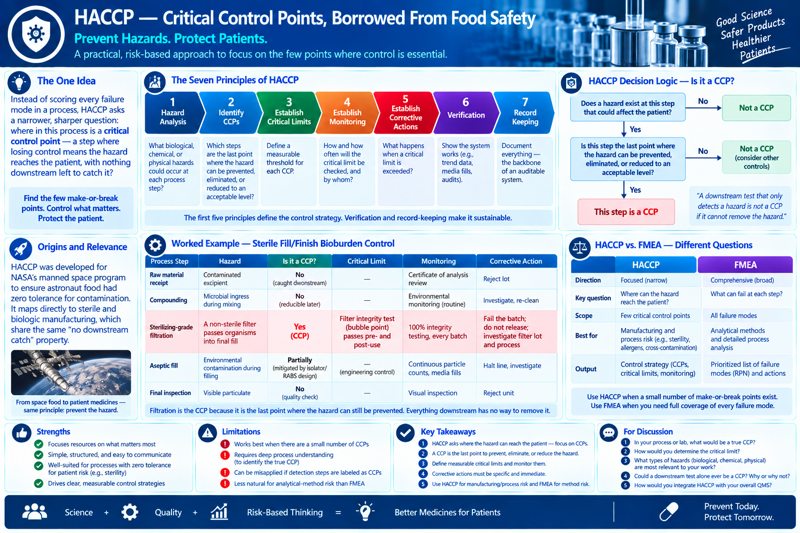
Hazard Analysis and Critical Control Points asks a narrower question than FMEA: not every failure mode in a process, but where the few points are whose failure directly threatens the patient — worked through a sterile-fill bioburden-control example.
A banner titled 'HACCP — Critical Control Points, Borrowed From Food Safety' with the tagline 'Prevent Hazards. Protect Patients.' and the note that this is a practical, risk-based approach to focus on the few points where control is essential. Panels: (1) The One Idea — instead of scoring every failure mode in a process, HACCP asks a narrower, sharper question: where in this process is a critical control point, a step where losing control means the hazard reaches the patient with nothing downstream left to catch it, captioned 'Find the few make-or-break points. Control what matters. Protect the patient.'; (2) The Seven Principles of HACCP — a seven-step chevron: hazard analysis (what biological, chemical, or physical hazards could occur at each step), identify CCPs (which steps are the last point where the hazard can be prevented, eliminated, or reduced to an acceptable level), establish critical limits (define a measurable threshold for each CCP), establish monitoring (how and how often the critical limit will be checked, and by whom), establish corrective actions (what happens when a critical limit is exceeded), verification (show the system works — trend data, media fills, audits), record keeping (document everything, the backbone of an auditable system) — captioned that the first five principles define the control strategy, and verification and record-keeping make it sustainable; (3) HACCP Decision Logic — Is It a CCP?, a flowchart: does a hazard exist at this step that could affect the patient (No → not a CCP); is this step the last point where the hazard can be prevented, eliminated, or reduced to an acceptable level (No → not a CCP, consider other controls; Yes → this step is a CCP), with the quote 'A downstream test that only detects a hazard is not a CCP if it cannot remove the hazard'; (4) Origins and Relevance — HACCP was developed for NASA's manned space program to ensure astronaut food had zero tolerance for contamination, and maps directly to sterile and biologic manufacturing, which share that same 'no downstream catch' property, captioned 'From space food to patient medicines — same principle: prevent the hazard'; (5) Worked Example — Sterile Fill/Finish Bioburden Control, a five-row table (raw material receipt, compounding, sterilizing-grade filtration, aseptic fill, final inspection) each with hazard, whether it's a CCP, critical limit, monitoring, and corrective action — sterilizing-grade filtration is the only 'Yes (CCP)' row (a non-sterile filter passing organisms into the final fill, critical limit is a filter integrity/bubble-point test pre- and post-use, 100% integrity testing every batch, corrective action is fail the batch, do not release, investigate filter lot and process), captioned that filtration is the CCP because it is the last point where the hazard can still be prevented — everything downstream has no way to remove it; (6) HACCP vs. FMEA — Different Questions, a comparison table across direction (focused/narrow vs. comprehensive/broad), key question (where can the hazard reach the patient vs. what can fail at each step), scope (few critical control points vs. all failure modes), best for (manufacturing and process risk, e.g. sterility, cross-contamination vs. analytical methods and detailed process analysis), output (control strategy — CCPs, critical limits, monitoring vs. prioritized list of failure modes (RPN) and actions), captioned 'Use HACCP when a small number of make-or-break points exist. Use FMEA when you need full coverage of every failure mode.'; (7) Strengths and Limitations — strengths (focuses resources on what matters most, simple/structured/easy to communicate, well-suited for processes with zero tolerance for patient risk e.g. sterility, drives clear measurable control strategies) and limitations (works best when there are a small number of CCPs, requires deep process understanding to identify the true CCP, can be misapplied if detection steps are labeled as CCPs, less natural for analytical-method risk than FMEA); (8) Key Takeaways — HACCP asks where the hazard can reach the patient, focus on CCPs; a CCP is the last point to prevent, eliminate, or reduce the hazard; define measurable critical limits and monitor them; corrective actions must be specific and immediate; use HACCP for manufacturing/process risk and FMEA for method risk. Footer: 'Science + Quality + Risk-Based Thinking = Better Medicines for Patients,' Temple University branding, and the tagline 'Prevent Today. Protect Tomorrow.'

The one idea

Instead of scoring every failure mode in a process, HACCP asks a narrower, sharper question: where in this process is a critical control point — a step where losing control means the hazard reaches the patient, with nothing downstream left to catch it?

Mechanics

HACCP originated in food safety (developed for NASA’s manned space program, to guarantee astronaut food had zero tolerance for contamination) and maps cleanly onto sterile and biologic manufacturing, which share that same “no downstream catch” property. The full method has seven principles; the ones that matter for a control-strategy discussion are:

  1. Conduct a hazard analysis — what biological, chemical, or physical hazards could occur at each process step?
  2. Identify critical control points (CCPs) — of all the steps, which ones are the point where the hazard can still be prevented, eliminated, or reduced to an acceptable level? A step downstream of the true control point is not itself a CCP, even if a hazard could theoretically show up there.
  3. Establish critical limits — a measurable threshold for each CCP (a temperature, a pressure differential, a bioburden count) that separates “in control” from “out of control.”
  4. Establish monitoring — how and how often the critical limit is checked, and by whom.
  5. Establish corrective action — what happens, specifically, the moment a critical limit is exceeded.

(The remaining two principles — verification and record-keeping — are the documentation backbone that makes the first five auditable, and aren’t specific to any one CCP.)

Worked example — sterile fill/finish bioburden control

StepHazardIs it a CCP?Critical limitMonitoringCorrective action
Raw material receiptContaminated excipientNo — caught downstream—Certificate of analysis reviewReject lot
CompoundingMicrobial ingress during mixingNo — bioburden reducible later—Environmental monitoring (routine)Investigate, re-clean
Sterilizing-grade filtrationA non-sterile filter passes organisms into the final fillYes — nothing downstream removes a missed organismFilter integrity test (bubble point) passes pre- and post-use100% integrity testing, every batchFail the batch; do not release; investigate filter lot and process
Aseptic fillEnvironmental contamination during fillingPartially — mitigated by isolator/RABS design, not a single measurable limit— (engineering control, not a CCP in the classic sense)Continuous particle counts, media fillsHalt line, investigate
Final inspectionVisible particulateNo — a quality check, not a hazard-elimination point—Visual inspectionReject unit

The filtration step is the CCP because it is the last point where the hazard (a non-sterile product) can still be prevented — everything upstream can be caught or corrected later in the process, and everything downstream has no way to remove an organism that already got through. That is the test for “is this a CCP,” not “could something go wrong here.”

When to reach for it vs. FMEA

FMEA decomposes an entire process into every failure mode and scores each one — useful when you want comprehensive coverage of a method or process. HACCP deliberately does the opposite: it narrows attention to the small number of points where losing control is unrecoverable, which is exactly right for manufacturing and process risk (sterility assurance, allergen control, cross-contamination) but a poor fit for analytical method risk, where FMEA’s step-by-step, fully-scored decomposition is what regulators and most labs actually expect.

Known weaknesses

  • Works best when there really are a small number of make-or-break points; forcing a HACCP structure onto a process with many, roughly-equally-important risks just reproduces an FMEA with extra steps.
  • Identifying the true CCP takes real process understanding — misidentifying a downstream inspection point as a CCP gives false confidence, since it doesn’t actually prevent the hazard, only detects it after the fact.
  • Less natural for analytical-method risk (where FMEA dominates) than for manufacturing/process risk, where it originated and still fits best.