Week 2 — Sep 21: Analytical Methods Development, the Modality Landscape, and Risk
Three things that have to be understood together before anything else in the course makes sense: how an analytical method actually gets developed and regulated, what is actually being made (the modality landscape), and how much evidence is enough (quality risk management).
(Lecture 2.) Week 1 argued that a method is a hypothesis about a molecule and that the discipline is built to revise it when the evidence says so. This week asks three questions that sit underneath everything else in the course: how does an analytical method actually get developed and regulated, what is actually being made, and how much evidence is enough? The third question is risk — assessed explicitly, not by reflex — and it’s the one this week is named for; the first two are the ground it stands on.
The one idea
A control strategy cannot be designed in the abstract — it is designed against a specific molecule, made by a specific process, measured by a method developed and validated for that purpose, with its own population of things that can go wrong. Before the course can teach how you measure something and how you control it, it has to teach what you are holding and how the method that measures it came to exist — then it can teach how much evidence is enough.
Analytical methods development and regulation
Every technique week for the rest of the term assumes a method already exists. This section is the one-page version of how it got there, so that assumption is never invisible:
Stage
What happens
Ties to
Analytical target profile (ATP)
State the requirement — analyte, matrix, range, accuracy/precision — before any column, wavelength, or probe is chosen
The regulatory expectation — captured in ICH Q14 — is that a method is designed against its validation targets and its analytical target profile from the start, not developed first and validated as an afterthought. Every worked method later in the course (chromatography, mass spec, spectroscopy) follows this same lifecycle; this is the only week that names it explicitly end to end.
What’s actually being made, and how much evidence is enough
Two more questions sit underneath every technique week: what is actually being made, and how much evidence is enough? Both get their own full treatment this week, in their own sections:
The modality landscape — a small molecule, a large molecule / biologic, and an advanced therapy compared side by side (size, manufacture, what “the molecule” even is, what purity means), plus why small molecule dominates entry-level hiring.
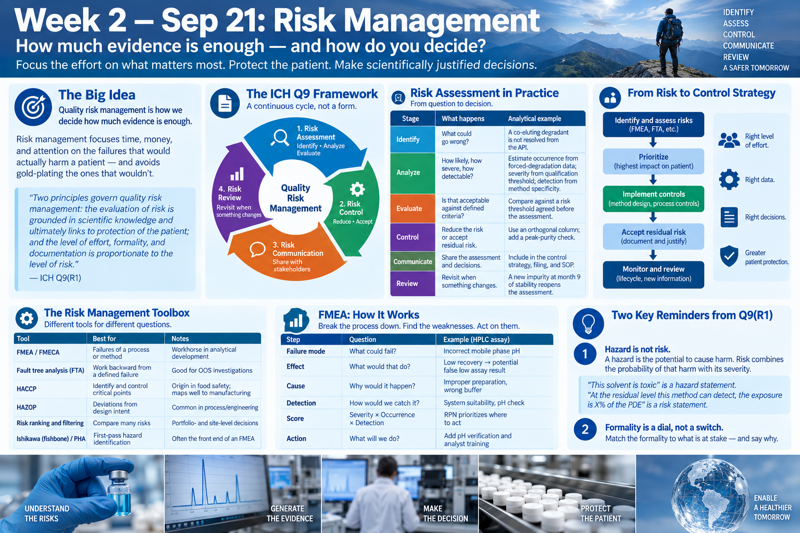
Quality risk management — the ICH Q9(R1) framework, the risk-management toolbox (FMEA, FTA, HACCP, HAZOP, risk ranking and filtering, Ishikawa/PHA, each with its own full walkthrough), and how a risk assessment becomes a control strategy.
The risk-homework thread
Three of the technique weeks later in the term — atomic spectroscopy, molecular spectroscopy, mass spectrometry — carry a risk-assessment assignment: take the method taught that week and build a method FMEA against a stated analytical target profile. The point is repetition: by the third checkpoint, scoring detectability should be a habit.
Where the analyst sits
Nobody hands you the modality landscape or the method-development lifecycle on day one — you infer them from the job posting, the SOPs on the shelf, and the first specification you’re asked to read. And in almost every method FMEA, the analyst is the only person in the room who knows the true detection score. A project manager can estimate severity; a process chemist can estimate occurrence; but whether the current controls would actually catch a failed extraction, a mis-integrated peak, a drifting calibration, or a co-eluting impurity before it reached a release decision is analytical knowledge, and if the analyst rounds it toward “we’d probably catch it,” the whole assessment is quietly wrong.
This is the STEAM “A” again: judgment about what the evidence can and cannot rule out. The refrain for the term — science → evidence → reduced uncertainty → control → regulatory confidence → patient trust — runs through method development above, and through the modality landscape and risk management in the sections that follow.
On the job
Read a job posting for an “Analytical Chemist I” or “QC Analyst” role and identify which column of the modality table it’s written against — the instrument list in the posting almost always gives it away.
Small molecule dominates entry-level hiring for a structural reason: there are simply more marketed small-molecule products, more generic and CDMO manufacturing sites, and more routine QC testing volume than for biologics or advanced therapies, which remain comparatively low-volume, specialised, and concentrated at fewer sites.
You will fill out, or be asked to sign off on, an FMEA far more often than you will build one from scratch — learn to read one critically before you learn to write one.
“Detection” is the column you’ll be asked about most, because you’re usually the only person in the room who actually knows what the running method would or wouldn’t catch. Don’t round it up to be agreeable.
A risk assessment that predates you (written by someone who’s since left) is still binding until it’s formally revisited — know how to find it, read it, and flag when it no longer matches reality.
For discussion
A job posting lists “HPLC, dissolution, ICP-MS” as required instruments. Which column of the landscape table is this role almost certainly in?
Why does “purity” require a panel of methods for a biologic but one method for a small molecule? Push past “it’s bigger” to the actual mechanism.
An advanced-therapy company is hiring far fewer analysts than a generic small-molecule manufacturer down the road, for a product that’s scientifically more sophisticated. Reconcile that with “the industry needs analytical skill.”
A method FMEA gives a mis-integration failure mode an RPN of 90 (S=9, O=2, D=5) and a wrong-diluent failure mode an RPN of 90 (S=5, O=3, D=6). Should they get the same attention? What does RPN hide here?
Your detection score for “co-eluting unknown degradant” depends on data you don’t have yet (forced degradation isn’t finished). How do you score it now, and what do you commit to?
The nitrosamine risk assessments concluded “no risk” for many products on the strength of a purge argument, with no confirmatory testing. When is a scientific argument enough, and when do you need the number?
Source note. Method-development framing follows ICH Q14 and ICH Q2(R2). See the modality landscape and risk management for their own sourcing. (Instructor: this session now absorbs what were two separate lecture weeks — confirm the pacing works in a single 3-hour slot.)
Before any technique week makes sense, the course needs to answer what is actually being made: a small molecule, a large molecule / biologic, and an advanced therapy compared side by side — size, manufacture, what “the molecule” even is, what purity means, and why small molecule dominates entry-level hiring.
ICH Q9(R1) as a loop, not a form: the risk-management toolbox (FMEA, FTA, HACCP, HAZOP, risk ranking and filtering, Ishikawa/PHA), FMEA in action, and how a risk assessment becomes a control strategy — worked through the nitrosamine risk assessments.