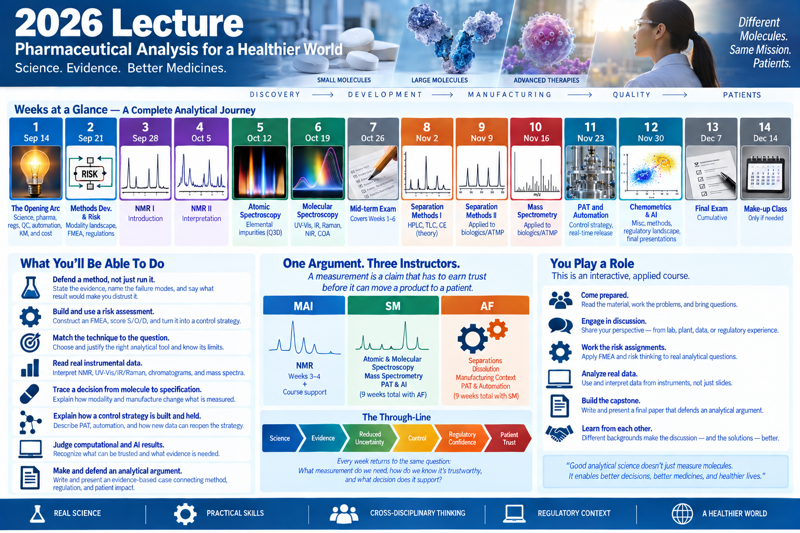
The 2026 course, week by week, aligned to the real syllabus and its three instructors (MAI, SM, AF). Week 1 opens the arc; Week 2 covers methods development, the modality landscape, and risk; Weeks 3–4 are NMR (MAI); Weeks 5–6, 8–10 teach each technique AF and SM lead in turn; Week 11 is PAT and automation; Week 12 is chemometrics, miscellaneous methods, and final papers — bracketed by the mid-term and the final exam.
This is the 2026 course, organised weeek by week to match the department’s actual syllabus. Each week has its own folder in the left menu.
What you’ll be able to do
By the end of the term, you should be able to:
Defend a method, not just run it. For any validated analytical method, state what evidence supports it, name its most likely failure modes, and say what result would make you distrust it.
Build and use a risk assessment. Construct a method or process FMEA, score severity, occurrence, and detection without inflating detection to look reassuring, and turn the assessment into a control strategy a regulator could follow (Week 2, and the risk-homework checkpoints in Weeks 5, 6, and 10).
Match the technique to the question. Given an analytical problem — an elemental impurity, an unknown degradant, a charge-variant shift, a polymorph question — choose and justify the right technique among NMR, atomic and molecular spectroscopy, chromatography, solid-state/thermal characterization, flow cytometry, and mass spectrometry, and state what that technique can’t tell you (Weeks 3–10).
Read real instrumental data. Interpret an NMR spectrum, a UV-Vis/IR/Raman trace, a chromatogram, or a mass spectrum well enough to identify a structure, flag a co-elution or ion-suppression artifact, or catch a spectral match that looks right but isn’t.
Trace a decision from molecule to specification. Explain how what’s being made — small molecule, biologic, or advanced therapy — changes which failure modes matter and how “identity” or “purity” is even defined, and read a Certificate of Analysis line by line back to the method and manufacturing step behind it.
Explain how a control strategy is built, held, and reopened. Describe the at-/on-/in-line measurement hierarchy and real-time release testing, and how a complaint or pharmacovigilance signal can force a control strategy that passed every existing test to be revisited (Week 11).
Judge whether a computational or AI-based result can be trusted. Distinguish predictive/chemometric models from generative AI by how each is governed, recognise information leakage or an out-of-domain prediction, and state what evidence a model needs before it can support a regulatory decision (Week 12).
Make and defend an evidence-based analytical argument in writing, naming a method’s failure modes and their detectability and connecting the technique to a regulatory expectation and a patient consequence (final paper and capstone).
One argument, taught by three instructors
The course is not a tour of instruments. It is a single argument — a measurement is a claim that has to earn trust before it can move a product or a patient — and it’s taught by three people: MAI, SM, and AF. AF and SM together lead nine of the term’s lecture sessions; MAI leads two (NMR); the rest are the mid-term, the final, and the occasional make-up.
NMR (Weeks 3–4, MAI). Introduction to NMR spectroscopy, then interpretation — the one part of the term AF and SM hand off entirely.
The AF/SM technique arc (Weeks 5–6, 8–10). Atomic spectroscopy and molecular spectroscopy (with UV-Vis and a Certificate-of-Analysis read-through) are taught on the small molecule alone; separation methods and mass spectrometry each add an applied case extending the same technique to biologics and advanced therapies. In between, Week 9 pivots to the specialized and solid-state techniques that don’t fit that main arc but are load-bearing in a real QC lab — DSC/TGA, X-ray powder diffraction and crystallography, flow cytometry, and dissolution. A risk-homework thread runs through the atomic-spectroscopy, molecular-spectroscopy, and mass-spectrometry weeks.
The mid-term falls after the first technique pair; the final is cumulative, with Week 14 held only if a make-up session is absolutely necessary. Every week returns to the same refrain: science → evidence → reduced uncertainty → control → regulatory confidence → patient trust.
Week 1 — Sep 14 is the opening arc in full, and it is substantial: it moves deliberately in one direction — science → pharma → regs — then reframes clinical development as the progressive removal of uncertainty and turns to the working detail: quality control across the supply chain, lab automation and process analytical technology, knowledge management, and the cost of development. It is the whole course in miniature; the weeks that follow slow down and do the work.
Work through each week’s sections in order; use the “On this page” list on the right to move within a section, and the ← / → buttons at the foot of each page to step through the course in sequence.
Lecture 1 in full: from what makes analysis a science, to what that science is for inside a company that discovers, develops, and sells medicines, to the regulations that govern every analytical decision — and on to quality control, automation, knowledge management, and cost.
Three things that have to be understood together before anything else in the course makes sense: how an analytical method actually gets developed and regulated, what is actually being made (the modality landscape), and how much evidence is enough (quality risk management).
Where UV-Vis measures molecules, atomic spectroscopy measures elements: flame and graphite-furnace AA, ICP-OES, and ICP-MS; the ICH Q3D risk-assessment and permitted-daily-exposure framework by element class; the method under USP ⟨232⟩–⟨233⟩; and the worked history of the withdrawn colorimetric heavy-metals test as a lesson in specificity. Carries the second risk-homework checkpoint.
UV-VIS and Beer’s law as the oldest quantitative measurement in the toolkit, then IR and Raman as complementary vibrational probes and near-IR as the broad-band signal only chemometrics can read — closing with a full read-through of a small-molecule Certificate of Analysis. Carries the second risk-homework checkpoint.
Mid-term examination covering Weeks 1–6: the opening arc, analytical methods development and the modality landscape, quality risk management and FMEA, atomic spectroscopy, and UV-Vis / molecular spectroscopy — with NMR as background from the MAI-led sessions.
Everything separations, in one session: the theory behind every separation (retention, selectivity, efficiency, resolution, van Deemter), the workflow that turns an analytical target profile into a validated LC method, forced degradation and the stability-indicating method, system suitability as the running proof a method still works, the wet-chemistry workhorses (Karl Fischer, titrimetry, ion chromatography), and how the same separation logic carries into biologics and advanced therapies.
Four techniques that sit outside the spectroscopy/separations/mass-spec mainline but are load-bearing in a real QC or characterization lab: DSC and TGA for solid-form and water/solvent content, X-ray powder diffraction and crystallography for polymorph and packing identity, flow cytometry as a general single-cell measurement instrument, and dissolution — the one routine test about the patient’s experience rather than the molecule’s identity.
Mass spectrometry as inference on top of one measurement: ionization and mass-analyzer trade-offs, targeted quantitation versus high-resolution identification, ion suppression and the stable-isotope internal standard — then the same physics doing heavier lifting on biologics and advanced therapies. Carries the third and final risk-homework checkpoint.
How a control strategy is built and held once a product is made for real: the at/on/in-line measurement hierarchy and soft sensors, real-time release testing, the continuous-manufacturing control strategy under ICH Q13, the model lifecycle, and how post-market signals — product complaints and pharmacovigilance — feed back to reopen a control strategy that looked adequate at the time.
Two threads in one session, as the syllabus intends: the rules for a trustworthy computational result (three kinds of ‘AI,’ the emerging regulatory framework) and the method that actually builds those models — chemometrics as machine learning with a 40-year head start, PCA, PLS, MCR, DoE, and the overfitting/leakage case that ties them together. Plus final paper presentations.
Cumulative final examination covering the whole course — fundamentals, risk and the modality landscape, atomic and molecular spectroscopy, separations, mass spectrometry, PAT and automation, and chemometrics/AI — with NMR as background from the MAI-led sessions.